Showing posts with label book. Show all posts

Saturday, 19 April 2014

Q for quinoa for #AtoZChallenge: warm nutty quinoa recipe with avocado and tomato

Quinoa is high in protein and lacks gluten, which makes it a wonderful choice for vegetarians, vegans and people with gluten intolerance.

warm nutty quinoa recipe with avocado and tomato by ServicefromHeart

The quinoa that we eat are actually quinoa seeds. They appear in red, black or commonly yellowish white (ivory). They are also high in magnesium, iron, phosphorus & dietary fiber. Every 100 g of cooked quinoa contains relatively high amount of (0.24 g) of amino acid lysine (Lys / K), with positively charged (basic) side chain in its biochemical structure. Lys is essential for tissue growth and repair.

Quinoa is also a source of vitamins B2 (riboflavin) and B9 (folate). Riboflavin may help reduce the frequency of migraine attacks through improving the cellular metabolism. Folate is essential for formation and development of new and normal body tissue.

Quinoa - affectionately referred to as the gold of Incas - originates from the Andean region of Ecuador, Bolivia, Colombia and Peru, in Latin America. The Incas referred to quinoa as mother of all grains.

In 2013 International Year of Quinoa, The United Nations General Assembly paid special recognition to Andean people of Peru who have prepared "a future sown thousands of years ago" through knowledge and practices of living in sync with mother nature. Harmonious living is one of our values, and I am happy to support such an ancient superfood. Yes, quinoa is listed as one of the superfoods for brains in the book 365 ways to boost your brain power by Carolyn Dean, Valentine Dmitriev, and Donna Raskin. It appears that quinoa is potentially good for our children to learn better, our parents and grandparents to minimize risks of dementia and Alzheimer's diseases, and ourselves to do better work.

For #AtoZChallenge on 2014 April 19 Sat, I lovingly present a recipe of warm nutty quinoa meal with avocado and tomato by ServicefromHeart. While you prepare this meal or enjoy it, listen to El Condor Pasa (If I could). Our favorite versions include the one by Simon & Garfunkel. 


Servings: 4
Preparation time: 5 minutes
Cooking time: 20 minutes

Ingredients:
♥ 1 cup quinoa
♥ 2 cups water
♥ 1/4 tsp salt
♥ 1 avocado
♥ 2 ripe tomatoes
♥ 2 tbsp nuts (almond / pistachio / cashew / walnut)
♥ 2 tbsp fresh herbs of basil / parsley
♥ 2 tbsp sesame oil
♥ 2 tbsp balsamic vinegar
♥ 1 tsp honey
♥ 1/2 tsp pepper
♥ 1 clove garlic, minced

Directions:
1. Rinse quinoa thoroughly to remove any toxic saponin.
2. Boil quinoa in salted water over medium heat for  5 minutes. Lower heat and simmer until water is absorbed.
3. Meanwhile, mince garlic, cut avocado and tomatoes into bite chunks. Quickly coat avocado chunks with balsamic vinegar to prevent them from turning dark.
4. After quinoa is cooked, fluff it.
5. Mix warm quinoa with sesame oil, honey, pepper, garlic.
6. Toss the mixture with avocado and tomatoes.
7. Garnish with nuts & herbs.

Tips:
♥ For better flavor, (1) if you have extra time, before boiling, lightly toast quinoa and nuts separately, until fragrant and (2) boil quinoa in broth instead of water.
♥ Toast over medium or low heat and stir constantly.
♥ Besides using balsamic vinegar, you can also coat avocado chunks with lemon juice.
♥ To fluff quinoa, I prefer using chopsticks - delicate extensions of human fingers. Fork is okay to fluff them too.

Other recipes that I love:
♥ Heidi Swanson's warm and nutty cinnamon quinoa- for breakfast- at 101 Cookbooks
♥ Susan Voisin's quinoa vegetable paella at FatFree Vegan Kitchen
♥ Lydia Walshin's  quinoa salad with tomatoes, feta and parsley at Perfect Pantry
♥ Tara Austen Weaver's China Forbes quinoa  at Tea and Cookies

Check also our other #5minutemeal recipes.

With love,
ServicefromHeart
20140419

Saturday, 8 March 2014

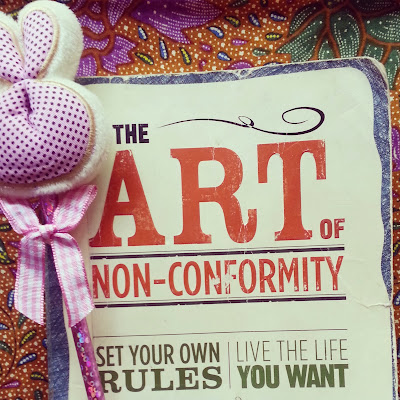
The art of of non-conformity {#readxp}

Book title: The Art of Non-Conformity: Set Your Own Rules, Live the Life You Want, and Change the World
Author(s): Chris Guillebeau, who has traveled to 193 countries!


ServicefromHeart book review on The Art of Non-Conformity by Chris Guillebeau
The Indiana Jones-alike cover of The Art of Non-Conformity.

Summary:

Chris introduced that many people are trapped in life situations (relationships, jobs, environments) that we are not entirely happy with. However, we conform to the situations (instead of exploring the alternatives) because of the following reasons:
1. ignorance of other choices
2. fear of uncertainty & change
3. fear of disappointing our loved ones
4. attachment (to people, money)

In friendly and energizing tones, Chris suggested ideas to create our desirable lives and circumstances through doing different or extraordinary things.

Some of us may find that not all ideas suggested are practical for our circumstances, especially if we have dependents (elderly parents, spouse, and children to take care), employees, subordinates who rely on us. To me, as long as I can learn an idea that is inspiring and worth sharing with others, I am happy and grateful.

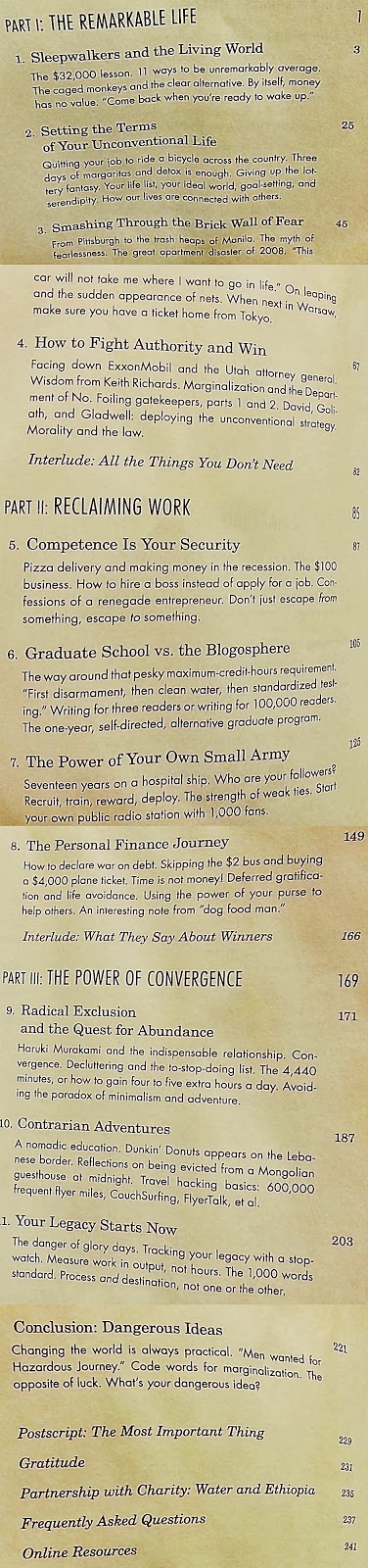
ServicefromHeart book review on The Art of Non-Conformity by Chris Guillebeau table  of contents

Ideas / Inspirations:

We can have unlimited ideas and dreams, but not unlimited priorities. We can do anything, but not everything (simultaneously).

♥ To prioritize, we can create stop-doing list / not-to-do list for things that consume a lot of our resources (physical energy, brain, time and money) but bring no or little happiness to ourselves and others.
"We tend to overestimate what we can complete in a single day and underestimate what we can complete over longer periods of time".

***

Some people may not be fortunate to have the opportunities to pursue a formal education. I personally know few of them and they are highly envious of others who are lucky enough to go school.

Some people may have enrolled themselves in a discipline (and subsequently a career) that they do not enjoy. It is okay, everything that happens to us has a reason that we can grasp only after the events.

The good news is as long as we are living, we can choose to consciously learn things that we love, knowledge and skills / crafts can bring happiness to ourselves and others through services or creations.

Lives are dynamic. No matter where we are in our personal and professional journeys, it is always a good idea to constantly learn, adapt, create and innovate.

Learning allows us to build our competence, commitment and character. These attributes are critical sources of our security and #innerstrength. 


♥ How is about designing a one-year, self-directed syllabus which is an alternative to attending a graduate school (as suggested by Chris)? 

Among Chris' recommendations, I jot down the following ideas (with few adaptations):

1. read The Economist, National Geographic, Nature, Science regularly (weekly / fortnightly / monthly) / religiously in Chris' word. 

2. read a book a week (so total 52 books in a year). Consider both no-fictions and classic novels / fictions. For the latter, my favorites include The Little Prince, Little Women, The Alchemist. How's about you? 

3. communicate / speak to public / tell stories to a wider audience.

4. learn a language (perhaps Arabic) through podcasts

5. learn computer programming language(s) and be functionally proficient

Since we design our own syllabus, we tend to take more personal responsibilities to pursue it with passion and enthusiasms.  


***

Dream! Pursue your dreams. Set goals, including scary goals.

♥ Risks are not that scary once we take them. Undertaking a courageous endeavor and achieving a success can greatly boost our confidence and motivate us to try more. As long as what we dream of being, doing, and having, cause no harm to others, or even better - spread goodness to others, just do it!

Questions:
1. "How can we make things better?"
2. What can we (uniquely) offer and serve the world?
3. Chris suggested that "the time to leave the best job is right before you get tired of it," but how would we predict when we are tired of it? A friend Xiang argues that it is only when we experience the feeling of being tired, then we realize that we are tired.

Quotes:
♥ "The toughest obstacles most of us have to overcome are the direct result of our own fears and insecurities." ~ Chris Guillebeau
♥ "Inaction breeds doubt and fear. Action breeds confidence and courage. If you want to conquer fear, do not sit home and think about it. Go out and get busy." ~ Dale Carnegie

Other reviews that I appreciate:
♥ Khaled Allen's book review @ Warrior Spirit
♥ Janelle's book review @ the20what 

Visit also other #readxp posts.

Happy reading! 

With love,
ServicefromHeart
201403

Monday, 17 February 2014

#readxp Happy Money the science of smarter spending

Book title: Happy Money: The Science of Smarter Spending
Author(s): Elizabeth Dunn (University of British Columbia / UBC, Vancouver, Canada) and Michael Norton (Harvard Business School)
Publisher: Simon & Schuster

Summary:
Liz and Mike proposed 5 main strategies or principles on spending money that can enhance our happiness, based on their and others' psychological research studies.

happy money ServicefromHeart Elizabeth Dunn Michael Norton book review

Buying experiences (e.g. trips, adventures, concerts, special meals) brings more happiness than buying material things (e.g. IT gadgets, cars, houses, swimming pools) does. Unlike material things that undergo depreciation in values, our past experiences get better when we re-think and re-feel about them.

Their suggestions to (1) turn our favorite things into treats (e.g. instead of having a cup of Starbucks coffee every morning, limit our access to perhaps a cup Starbucks coffee once in a while) and (2) pay now , consume later (as opposed to credit culture of consume now, pay later), appear to me deeply rooted in delayed gratification. It is in the delay that human beings enjoy the pleasures of anticipations, such as planning for trips.


Ideas / Inspirations:
♥ Thinking about money (that we don't have at the moment) can discourage us from taking actions that promote happiness.
♥ People will think that an irrigation pump costing $250 is expensive, but Kickstart phrases it beautifully to appeal to our nobler motivation. "You give us $250, and we'll get a family our of poverty - forever."
♥ Giving money away can create wealth e.g. Pepsi Refresh Project grants.
♥ To be happier, watch less TV, spend more time (if necessary buy time) to play with our children or walk our dog. Consider how a particular purchase will affect our time.
♥ Many people sacrifice much of their time in efforts to save a little money, for example through comparison shopping (this effort in turn can influence us to pay more for features that do not bring happiness).
♥ Invest in others brings happiness only if we are not feel pressured or compelled to give.
♥ Relationships and connections matter. For example, Better World Books create connections between donors and recipients. Consequently, they have happier donors.  
♥ Giving our children and ourselves treats instead of daily consumption of our favorite things may boost happiness. I am going to try this principle on baby Ren with his favorite strawberry!

Questions:
1. Since the findings of the books (e.g. the authors proposed that people are happier spending money to purchase experience than material things) are based on averages or majorities of responses, this does not mean that everyone will have the same preference. Ask ourselves, especially for large amount purchases, will we be happy 1 week, 1 month, 1 year after spending money in exchange of a particular experience or a material thing? 
2."Who makes us happier, our significant others or strangers?"
3. What is our happy ratio of "money spent on ourselves" over "money spent on others"?  Based on a study quoted in the book, > 600 Americans report an average ratio of > 10 to 1.

Quotes:
♥ "Some 57 percent of Americans reported that the experiential purchase made them happier than the material purchase, while only 34 percent reported the opposite."
♥ "When undergraduates wrote a summary of their "life story" (at the tender age of approximately 19), they were more likely to mention experiential purchases, rather than material goods."
♥ The chef Ferran Adrià has a goal to turn "eating into an experience that supersedes eating."

Other reviews / interview that I appreciate:
♥ Goodreads' members' reviews
♥ How money actually buys happiness at Harvard Business Review
♥Chuck Sambuchino's interview

Visit also other #readxp posts.

With love,
ServicefromHeart
20140217

Thursday, 13 February 2014

Create reading experience #readxp that makes us happy and wise


#readxp reading experience baby learn ServicefromHeart

When I was studying in Malaysia, one of my favorite activities (homework) was to write about reading experience (读书心得). The homework greatly helped me in learning Chinese Mandarin and had encouraged me to be a more optimistic person than ever.

When we jot down our reading experience, we clarify our thoughts and understandings. We are also doing our future selves a favor. We could quickly recall what we learned from a non-fiction book or instantly re-enjoy the pleasure or excitement we experienced from a story book.

To create reading experience, we can write, doodle, draw, take photographs, record audio notes or videos. Use approaches that we like best.

Our reading experience can be as simple as a word or a picture.

Things that we can also include in our reading experience:
♥ book title, author(s), publishers
♥ summary
♥ ideas
♥ inspirations
♥ questions
♥ impressions
♥ feelings
♥ quotes
♥ review

The summary section can simply be main gist of the book, in a sentence, a paragraph, or a list.

The idea section can include ideas straight from the book or ideas that we conceive upon integrating our existing knowledge with the new one from the book.

Keeping a note of quotes is useful to train our mind. Quotes can serve as advices or affirmations that nourish our soul. Positive quotes can act as instant switches in time of crisis, to quickly and gently shift our moods and emotions away from negativity.

Finally, the review section can include things (e.g. contents, plots, styles) that inspires us, things that can be better, or comparisons with other books.

Writing reading experience is similar to documenting our travel experience. When we travel, our minds and bodies travel. When we read, our minds travel. We can enhance our reading experience by using more imaginations and discussing with others who have read the book or arguing with the authors (known as active reading). Note down our questions. Sometimes, if not many times, we may not get the answers from the authors, but from other people.

Since 2014, I started to be more organized in my reading adventures. We believe that sharing is caring, so I try my best to share my reading experience in easy to digest posts.

To facilitate faster search, try #readxp for the blog, Twitter and Instagram of ServicefromHeart. You are always welcome to share your #readxp!

With love,
ServicefromHeart
20140214