Showing posts with label psychology. Show all posts

Tuesday, 24 June 2014

Just keep shipping ~ a secret of creative and productive people

"The reason I've managed a modicum of success is because I just keep shipping." ~ Seth Godin in 99% Conference, 200804

In a broader context, "shipping" here means creating and sending stuff out. You "ship" when you deliver something.

The definition includes when you:
  1. transform your consumption of knowledge into productions of designs, prototypes and masterpieces
  2. file patents
  3. deliver a talk / workshop
  4. sell a (beautiful / useful / innovative) product
  5. send your creative / fiction / scientific manuscript to publisher(s)
  6. perform your (music, singing, dancing) talent into tangible digital pieces
  7. release your work to the world 
  8. debut your latest artwork in a gallery 
  9. startup a company
  10. ... and the list goes on.
Those who ship, after perspiring sweats (and sometimes tears and blood), are admirable. A reason is that shipping, as the final act of execution, happens much less than people expect.

For you who pursue creative endeavors, the requirement to ship is even higher than ever.

To ship with high frequency, you know that you have to overcome some of major emotional barriers in your inner rugged landscape.

The barriers are like high hills and mountains when you are trapped in a valley, or strong currents when you have to move toward the opposite direction. The barriers of insecurity, fear (of failure, imperfection, criticism), inertia (due to procrastination or perfectionism) and resistance will always be there. Sometimes, we forget that we can cross over the barriers, because we are occluded by them.

You, however, have learned strategies to cross over the barriers.

You may have heard of the roles of amygdala, an almond-shaped structure found deep on either side of the brain, that evolved in early vertebrates.

Your amgydala is a wonderful ally. It links sensory (mainly visual and auditory) experience with emotional significance.  The emotionally-arousing memories that are formed and stored in amygdala, include those related to fear. For example, if you see a danger approaching, your amygdala learns about the fear stimulus and  mediate the associated fight-or-flight responses.


Undeniably, fear is an emotion essential for the survival of our ancestors and ourselves. However, we also subconsciously experience fear in situations when this emotion is inappropriate and discouraging creativity and productivity.

Now, you may be tempted to quiet your amygdala.

While it is impossible to live without fear, despite the adage of "have no fear", you can choose to embrace your fear wisely.

Prioritize your fear. If you can allow your fear of being unproductive to rule over your fear of criticism or perfectionism, you will ship more often.

♥♥♥

The first law of thermodynamics states that energy can be converted from one form to another, but that it cannot be created or destroyed. Since all energy forms are (in principle) interconvertible, it is highly possible to convert your fear into positive energy. The process can be effortless, for the experienced creative converters.

The next question is how to convert the fear into positive energy.

Remember that our body, plants and animals are made up of molecules of atoms. When we eat plant- or animal-based meals, the chemical energy present in their molecules is converted into thermal motion, known as heat energy. The heat energy in turn catalyzes reactions inside our cells.

In an analogous way, you can convert your fear into positive energy, by carefully internalizing the (right) fear and selecting the optimum catalysts to harvest its energy. Think of inner strength such as self-control, discipline, and openness to constructive feedback.

♥♥♥

In Feel the Fear and Do It Anyway (which was rejected many, many times in its shipping attempts to the right publisher), Susan Jeffers highlights that "the initial stages are the most difficult and require the greatest concentration."

Be determined enough to leave the port of your comfort zone.

Ship by the end of the hour, the day, and the week.


A step by a step, even if it is just a tiny one, you weather every rack of internal and external storms and thunders.

Remember to sprinkle and drizzle your journey with a little more courage, passion, perseverance, and patience. You are almost there.

"O Captain! My Captain!"

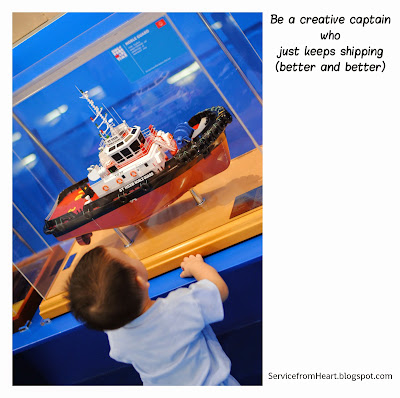
Be a captain of your ships who just keeps shipping (better and better)!
Just keep shipping ~ a secret of creative and productive people ServicefromHeart

Many thanks
ServicefromHeart
20140624

Tuesday, 17 June 2014

Overcome the shame of imperfection

Have anyone said "shame on you" to you before?

It does not feel good being reproved, even if you have done something wrong.

When we were younger, that someone can be a person of authority, such as parents, teachers, religious leaders or peers. Their words might made a permanent imprint in our mind.

As a grown-up, that someone can also be your inner judge, whom you may NOT aware well. The judge learn the laws through your years of experiences and past interactions with others.

To overcome shame, we must first understand shame and its relationship with guilt.

Could you please tell me the difference between shame and guilt?
In shame, we feel that we are bad.
In guilt, we feel that we have done something bad.

In my perspective, if a child makes a mistake, it is better for him to feel sorry for his inappropriate action than to feel ashamed of himself. What's your view?

In Spiritual Capital, Danah Zohar rated both shame and guilt -7 in a scale of motivation from -8 to +8, which corresponds to negative and positive motivations, emotions and drives that propel our lives and actions.

She defines shame as having no right to be here.

For individuals, both shame and guilt are more discouraging than fear (-4), craving / greed (-3), and anger (-2).

When we experience shame and guilt, it is extremely hard to listen to our inner voices, to be creative and create something out of passion.

There are many forms of shame. An extreme one is the shame of existing. Other forms include the shame of addiction, shame of illness such as cancers and diabetes.

The Confucian virtues include shame. While other Confucian virtues of loyalty, filial piety, benevolence, love, harmony, courtesy and integrity appear to be positive motivators, the (lost-in-translation) shame that Confucius referred to is the judgement and the sense of right and wrong.

Sadly, many times we feel ashamed because we are not good enough in our life, work, study, look, sport, and the list goes on. We need more courage to ignore this form of shame -- the shame of imperfection.

To overcome fear (-4) or a sense of being threatened or too vulnerable, one has to first overcome shame and guilt (-7).
"We all have shame. We all have good and bad, dark and light, inside of us. But if we don't come to terms with our shame, our struggles, we start believing that there's something wrong with us -- that we're bad, flawed, not good enough -- and even worse, we start acting on those beliefs. If we want to be fully engaged, to be connected, we have to be vulnerable. In order to be vulnerable, we need to develop resilience to shame." ~ Daring Greatly: How the Courage to Be Vulnerable Transforms the Way We Live, Love, Parent, and Lead by Brené Brown of University of Houston Graduate College of Social Work
Sometimes, we may experience shame because we do not fit in. We do not always fit in to the ideals expected and determined by others (parents, teachers, bosses, society or media).

The good news is we can learn to be aware of the difference between fitting in and belonging, both concepts are often thought as being synonymous but they can be quite different and have significant influences on our choices, emotions and well-beings. Having such an awareness helps us to develop resilience to shame.

Could you please tell me the difference between fitting in and belonging?
To fit in, one assesses a situation and changes to be accepted (by others).
To belong means just be yourself, accept yourself and you will be accepted (by others who really care about you).

"The shaming culture we live in makes it harder than ever to show courage and be vulnerable" but if a person starts overcoming shame, he or she can have a viral effect to people whom he or she influences.

For example, as a big sister I would like my sister to love her healthy body (she used to idealize the very slim figures of models) and as an aunt I would love my niece Michelle to love her hair (ignore some people who said she has too little hair to grow long hair).

Instead of telling them or nagging to love their bodies and looks - the gifts that God and nature have bestowed to them, I choose to be a positive role model, a servant leader by loving my body, look, style and appearance. I am grateful for every cell, organ, part and feature of my face and body.

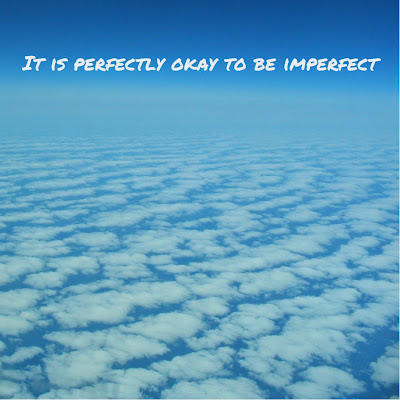
Let us learn from the nature. The clouds are not perfect yet they are beautiful. It is perfectly okay to be imperfect. No more shame, but more courage to be imperfect.

ServicefromHeart overcome shame of imperfection

With love,
ServicefromHeart
20140617

Monday, 17 February 2014

#readxp Happy Money the science of smarter spending

Book title: Happy Money: The Science of Smarter Spending
Author(s): Elizabeth Dunn (University of British Columbia / UBC, Vancouver, Canada) and Michael Norton (Harvard Business School)
Publisher: Simon & Schuster

Summary:
Liz and Mike proposed 5 main strategies or principles on spending money that can enhance our happiness, based on their and others' psychological research studies.

happy money ServicefromHeart Elizabeth Dunn Michael Norton book review

Buying experiences (e.g. trips, adventures, concerts, special meals) brings more happiness than buying material things (e.g. IT gadgets, cars, houses, swimming pools) does. Unlike material things that undergo depreciation in values, our past experiences get better when we re-think and re-feel about them.

Their suggestions to (1) turn our favorite things into treats (e.g. instead of having a cup of Starbucks coffee every morning, limit our access to perhaps a cup Starbucks coffee once in a while) and (2) pay now , consume later (as opposed to credit culture of consume now, pay later), appear to me deeply rooted in delayed gratification. It is in the delay that human beings enjoy the pleasures of anticipations, such as planning for trips.


Ideas / Inspirations:
♥ Thinking about money (that we don't have at the moment) can discourage us from taking actions that promote happiness.
♥ People will think that an irrigation pump costing $250 is expensive, but Kickstart phrases it beautifully to appeal to our nobler motivation. "You give us $250, and we'll get a family our of poverty - forever."
♥ Giving money away can create wealth e.g. Pepsi Refresh Project grants.
♥ To be happier, watch less TV, spend more time (if necessary buy time) to play with our children or walk our dog. Consider how a particular purchase will affect our time.
♥ Many people sacrifice much of their time in efforts to save a little money, for example through comparison shopping (this effort in turn can influence us to pay more for features that do not bring happiness).
♥ Invest in others brings happiness only if we are not feel pressured or compelled to give.
♥ Relationships and connections matter. For example, Better World Books create connections between donors and recipients. Consequently, they have happier donors.  
♥ Giving our children and ourselves treats instead of daily consumption of our favorite things may boost happiness. I am going to try this principle on baby Ren with his favorite strawberry!

Questions:
1. Since the findings of the books (e.g. the authors proposed that people are happier spending money to purchase experience than material things) are based on averages or majorities of responses, this does not mean that everyone will have the same preference. Ask ourselves, especially for large amount purchases, will we be happy 1 week, 1 month, 1 year after spending money in exchange of a particular experience or a material thing? 
2."Who makes us happier, our significant others or strangers?"
3. What is our happy ratio of "money spent on ourselves" over "money spent on others"?  Based on a study quoted in the book, > 600 Americans report an average ratio of > 10 to 1.

Quotes:
♥ "Some 57 percent of Americans reported that the experiential purchase made them happier than the material purchase, while only 34 percent reported the opposite."
♥ "When undergraduates wrote a summary of their "life story" (at the tender age of approximately 19), they were more likely to mention experiential purchases, rather than material goods."
♥ The chef Ferran Adrià has a goal to turn "eating into an experience that supersedes eating."

Other reviews / interview that I appreciate:
♥ Goodreads' members' reviews
♥ How money actually buys happiness at Harvard Business Review
♥Chuck Sambuchino's interview

Visit also other #readxp posts.

With love,
ServicefromHeart
20140217